Beyond the Interface – Disrupting the Market

beyond-interface-main

Exhibition & Panels at ISMAR, The International Symposium on Mixed and Augmented Reality, Munich, Germany.

Panel: Disrupting the Market
Thursday 11 September, 2014 02:00 PM, ISMAR 2014, Technical University of Munich, Boltzmannstraße 15, 85748 Garching /Munich. With: Heath Bunting, Tatiana Bazzichelli, Annette Domz and Wolf Lieser. Chaired by Marc Garrett

This panel looks at alternative approaches to understanding creative digital industries, marketing and power, and focuses on the boundary between cultural and financial, governmental and political economies. The speakers will examine a range of tactical strategies and disruptive approaches as part of an evaluation of the economic hierarchies in contemporary society and creative production. This discourse will present recent examples that critique traditional approaches to participation within market driven systems, with a particular focus on networked culture, mixed realities, social media, ubiquitous computing, and mass surveillance. More info

Exhibition: Beyond the Interface, curated by Marc Garrett, Julian Stadon.
Date: 10-12 September 2014, Faculty for Architecture Level 5, Technical Universsity campus, Arcisstrasse 21 80333 Munich. With: Erica Scourti, Jennifer Chan, Branger_Briz, Julian Oliver, Mez Breeze, Heath Bunting, Pierre Proske, Genetic Moo, Zach Blas.
More info here

Disrupting Business @ Art Meets Radical Openness

radical_art_servus_52mmTatiana Bazzichelli is curating a Disrupting Business Conference Track at the Art Meets Radical Openness Festival in Linz, Austria (28 May – 1 June, 2014).

The festival, under the theme “Autonomy (im)possible?”, is dedicated to art, hacktivism and open culture and organised by Us(c)hi Reiter – servus.at, with the contributions of external curators: among Tatiana Bazzichelli, Heath Bunting, and Margaritha Köhl (read more about the team here).

Disrupting Business at Art Meets Radical Openness Festival

The increasing commercialisation of sharing and networking contexts is transforming the meaning of art and that of business. Business is progressively adopting hacker and artistic strategies of disruption in the field of social media and information technology. In the business culture, disruption not only means rupture, but innovation and the re-design of behavioural tendencies, acting in ways that the market does not expect.

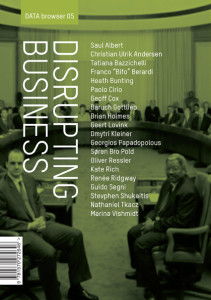
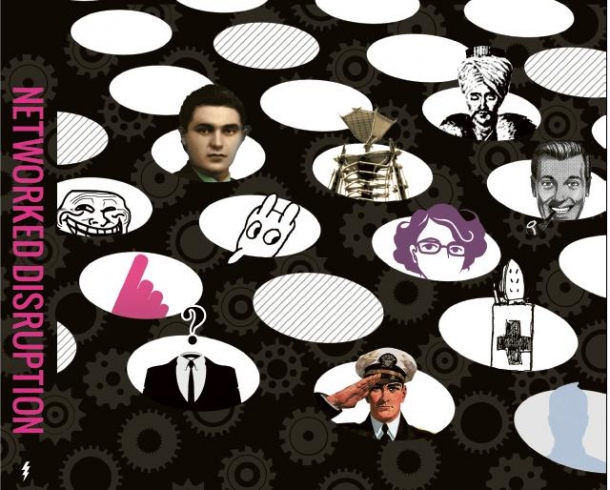
The Wikipedia Encyclopaedia shows the example of ‘new-market disruption’ caused by the GNU/ Linux Operating System, which initially was inferior in performance to other server operating systems like Unix and Windows NT, but by being less expensive and collectively improved, in 2010 Linux was installed in 87.8% of the worlds 500 fastest supercomputers. As pointed out by Tatiana Bazzichelli in her book Networked Disruption (2013) and in Disrupting Business (co-edited with Geoff Cox, 2013), to investigate the progressive commercialisation of sharing and networking platforms, it is necessary to understand business culture from within. What is the challenge facing artists and activists working on a critical dimension of networking?

Saturday May 31, 19:00-19:40
## Disrupting Business: Towards a Critique of Art & Activism
by Tatiana Bazzichelli
http://www.radical-openness.org/programm/2014/disrupting-business-towards-critique-art-activism

At the core of this presentation is Tatiana Bazzichelli’s research on business disruption as artistic and activist practice. Her hypothesis, described in the book Networked Disruption (2013) is that mutual interferences between art, hacktivism and the business of social networking have changed the meaning and contexts of political and technological criticism. Hackers and artists have been active agents in business innovation, while at the same time also undermining business. Artists and hackers use disruptive techniques of networking within the framework of social media, opening up a critical perspective towards business to generate unpredictable feedback and unexpected reactions; business enterprises apply disruption as a form of innovation to create new markets and network values, which are often just as unpredictable.

Bazzichelli proposes the concept of the Art of Disrupting Business as a form of artistic practice within the current economical and political framework. The notion of disrupting business becomes a means for reflecting on immanent practices of hackers, artists, networkers and entrepreneurs, highlighting empirical and theoretical interconnections and contradictions, as multiple layers of intervention.

Saturday May 31, 20:30 – 22:30
## Openness and Liberty as Business Disruption
Panel with Marc Garrett /Furtherfield, Karlessi /Ippolita collective,
Nathaniel Tkacz /MoneyLab. Moderated by Tatiana Bazzichelli.
http://www.radical-openness.org/programm/2014/openness-and-liberty-business-disruption

This panel traces the shift in the meaning of “openness” and “liberty” in relation to forms of “business disruption”. Since some years a certain vocabulary of freedom and peer collaboration has been adopted by the rhetoric of IT business and social networking. Do-It-Yourself, sharing knowledge, hackability, and similar concepts first witnessed in the underground interventionist realm of hacker culture and networked art are today the core business for many enterprises. Many hackers and activists have pointed out that the rhetoric behind Web 2.0 has been via a progressive appropriation – and often, disambiguation – of hacker and cyber utopias of the 1980s-1990s.

In this panel activists and critical thinkers reflect on the subject of co-optation of radical values by business models, shedding light on the constant paradox of being functional to the system while trying to disrupt it. Are openness and liberty forms of business disruption by empowering flexible mechanisms of revenues and the technical genealogy” of anarcho-capitalism?

# Insider Liberties: A Technical Genealogy of Cryptography by Karlessi.
From cypherpunks to WikiLeaks and beyond. We will trace a genealogy of liberties’ concepts and their technical implementations, leading from the cypherpunk movement (1990s) to WikiLeaks. We will focus specifically on cryptography as the key-concept in order to foster, and defend, liberties. Cryptography is in some way a disruptive concept and practice. In this endeavour, we only use archives, to employ a foucaldian terminology (Foucault 1969), provided by documents widely published on the Web. We don’t have any insider information, leak or whistle-blown secret. Nevertheless, we are insiders via our methodology because we are not stranger to this genealogy, we are part of it, we are involved in the construction of digital worlds since before the Web. We just use a vast amount of data and act as human filters to reconstruct a reliable account in reasonably good time.

# Marc Garrett will discuss the critical intentions behind Furtherfield, its online community, the physical Gallery space, and the new Furtherfield Commons and lab space, and its role as a radical arts collective. For over 17 years Furtherfield has engaged in Art, Technology and Social Change. Through this grounded knowledge, he and his peers have witnessed that the mainstream art world as becoming less relevant, due its reliance on neoliberal values through its unregulated, marketing economies. If we are to disrupt the powers these conditions we need to build beyond our silos and offer valid forms of imaginative emancipation, we need something closer to people’s actual needs. He sees connections between Radical Enlightenment from the 1800s, to new forms of critical theory and art activism as possible solutions, and this includes the practices of Hacktivism, Situationism, Net Art, Media Art practice, P2P culture and networked art, alongside punk, DIY and DIWO culture.

# Open Organisation and Monstrous Markets: How to be ‘Actually Disruptive’, by Nathaniel Tkacz
What does an open mode, an open form of organisation look like? What are the specific problems that it responds to and how does it constitute itself? The problem or challenge of openness is not at all new, and it has always been well suited to certain neo-liberal ‘rationalities’. A lot of seemingly progressive aspects of openness (collaboration, participation, merit, ad-hocracy, spontaneous organisation, forking, and so on) are in some ways old arguments in new clothes. Perhaps the biggest question, or challenge, for openness is its relationship to the ideology of the market in neoliberal thought. This presentation reflects upon the concept of openness as an emancipatory project, questioning organisation structures, and beyond that, economic logic. The presentation ends by turning to recent market experiments in network cultures, experiments that are both compatible with some liberal and libertarian doctrines, but take the logic of the market in monstrous directions.

More about AMRO Festival here:
http://www.radical-openness.org/
The Art of Disrupting Business (Video)

My talk “The Art of Disrupting Business” has been selected for re:publica 14.
Scheduled on May 8, 2014 – 10:00 to 11:00, at re:publica festival in the STATION-Berlin in Berlin-Kreuzberg.

Short thesis:
Tatiana Bazzichelli describes the concept of “disruptive business” as an art practice, Her analysis becomes an opportunity to imagine new possible routes of social and political action. Distributed, autonomous and decentralised networking practices of disruption become a means for rethinking oppositional hacktivist and artistic strategies within the framework of art and business.

Watch the video!

Description:
The objective of this talk is to rethink the meaning of critical and oppositional practices in art, hacktivism and the business of social networking. The aim is to analyze hacker and artistic practices through business instead of in opposition to it. Shedding light on the mutual interferences between networking participation and disruptive business innovation, this talk explores the current transformation in political and technological criticism. The analysis poses the following question: Is it possible to respond critically to business without either being co-opted by it or refusing it? Is criticism only possible through opposition? Bazzichelli’s hypothesis is that mutual interferences between art, hacktivism and the business of social networking have changed the meaning and contexts of political and technological criticism.

Hackers and artists have been active agents in business innovation, while at the same time also undermining business. Artists and hackers use disruptive techniques of networking within the framework of social media, opening up a critical perspective towards business to generate unpredictable feedback and unexpected reactions; business enterprises apply disruption as a form of innovation to create new markets and network values, which are often just as unpredictable.Bazzichelli proposes the concept of the art of disrupting business as a form of artistic intervention within the business field of Web 2.0. The notion of disruptive business becomes a means for describing immanent practices of hackers, artists, networkers and entrepreneurs, which are analysed through specific case studies.

More info about re:publica 14 here: http://re-publica.de/

Business Disruption at “OMG Agorà” Milan

How “disruption” creates innovation and business

Tatiana_Bazzichelli_Disruptive_Loop_Diagram

The media sociologist Tatiana Bazzichelli, expert on the contaminations between art, hacktivism and the business of social media, and curator of the transmediale Festival in Berlin, was guest of the last meeting “OMG Agora” – program of conferences organized in Milan by the OMG (Omnicom Media) Group for their customers (June 13, 2013).

During the meeting, dedicated to the discovery of mutual interference and critical analysis of the practices of networking through the concept of business disruption, the networker has presented the model “Disruptive Loop Diagram” showing how from perturbation can arise innovation. Disruption is therefore a creative moment, a strategy and methodology to generate new approaches and forms of business, and to investigate possible new network markets .
Tatiana Bazzichelli traced the rise of digital culture, the critical practices of hacking and net art, and a constellation of social networking projects that use the strategy of “disruption” to imagine new configurations of business. Artists and hackers are in fact often active agents of market innovation, using strategies of networking in the field of social media by generating often unexpected feedbacks.

More info: OMG Group

Interrupção em Rede: Speaking about Networked Disrpution at USP – São Paulo University

Interrupção em Rede: Repensando Oposições em Arte, Hacktivismo e Negócios da Rede Social

Following the aim to connect together institutions, artists and researchers within the contemporary media culture scenario, in the time-frame 11th May – 3rd June, 2013, Tatiana Bazzichelli traveled to Brazil to get in contact with local and translocal projects, events and institutions working critically with art, technology, politics and identity. The main destinations were: the city of Rio de Janeiro and the city of São Paulo. The travel combined the visit of independent art spaces, meeting with artists, curators and cultural producers and a series of lectures dedicated to Bazzichelli’s field of research and curatorial activity.The video above (Language: Italian and Portuguese) is the documentation of the talk “Networked Disruption”: Arte e hacktivismo em debate: at the São Paulo University /USP: Universidade de São Paulo, within the seminar: SincretiKa Digital & ECA: Subjetividade ubíqua entre cultura digital e metrópole comunicacional (organized and moderated by Prof. Massimo Canevacci), which took place on 23.05.13.

The day after, the book “Networked Disruption” was also presented by Tatiana Bazzichelli at the CED – Centro de Estudos do Corpo, Pontificial Catholic University of São Paulo (Media Body Research Group). With Prof. Helena Katz (arranged by performance artist and researcher Sheila Ribeiro).

Networked Disruption @ Cyber*Resistance

IMG_5705_2
April 4-6, 2013: CYBER*RESISTANCE at Cantiere Social Center, Milan, Italy

Tatiana Bazzichelli presents the book Networked Disruption: Rethinking Oppositions in Art, Hacktivism and the Business of Social Networking, during the event Cyber*Resistance at the Cantiere Social Centre in Milan. 3 DAYS of workshops, debates, presentations, exhibitions, workshops, music, installations, live performances, artivism, sharing of knowledge and social activism around the use of new media and new technologies.
The book is presented during the panel “Anonymous and the Net” with Tatiana Bazzichelli, Carola Frediani, and AnonItaly.

Networked Disruption – Book Launch

networked disruption tatiana bazzichelli

Tuesday, 26 March 2013, 20:00 – late
c-base (Rungestraße 20, 10179 Berlin, S/U Jannowitzbrücke)

The event reSource 004: Networked Disruption (part of the series of event by the reSource transmedial culture berlin) reflects on how the current techno-economic paradigm of Web 2.0 has challenged notions of art and hacktivism. Named after the just-published book by Tatiana Bazzichelli Networked Disruption: Rethinking Oppositions in Art, Hacktivism and the Business of Social Networking (DARC Press, 2013), the event discusses new strategies of political and social criticism, by reflecting on mutual interferences between art, hacktivism and business disruption.

Hackers, activists, artists, practitioners and theoreticians are invited to reflect with us on the current development of artistic and hacker practices in the context of social networking. How can hackers and artists be critical in the business context of social media? Is the business of social media co-opting DIY culture? Is criticism only possible through opposition? These are some of the questions we will share with the public during the panel.

By proposing the concept of disruptive business as an art practice, reSource 004: Networked Disruption becomes an opportunity to imagine new possible routes of social and political action. The event presents a constellation of social networking projects that challenge the notion of power and hegemony, from the earlier development of network culture to today.

We will reflect on the meaning of disruption today by connecting practices of networked art and hacking in California and Europe, such as mail art, Neoism, The Church of the SubGenius, Luther Blissett, Anonymous, Anna Adamolo, Les Liens Invisibles, the Telekommunisten collective, The San Francisco Suicide Club, The Cacophony Society, the early Burning Man Festival, the NoiseBridge hackerspace, and many others.

Networked Disruption is presented by Tatiana Bazzichelli (it/de), in conversation with Michael Dieter (au/nl), Alexander Müller/Hedonist International (de), and the public of c-base. Moderated by Kristoffer Gansing (se/de).

After the book presentation and discussion, the dj/vj/xj Podinski (XLterrestrials + CiTiZEN KiNO) will mix a culture jammer’s “smorgasbord” of counterculture beats and hijacked eyecandy from the 90s and up to various post-9/11 situations. Expect un-soothing audio-visual chaos!

More info here.

Download the book here.

Or buy the hard copy online (available also on Amazon.com and Amazon Europe)

Disrupting the Bureaucracy, Rethinking Social Networks

Conference -Networks – Fri 01.02.2013 – 15:00
transmediale festival 2013, BWPWAP, Auditorium, Haus der Kulturen der Welt, Berlin

 Includes a performative rubber-stamp intervention by Lutz Wohlrab, and Karla Sachse.
Disrupting the Bureaucracy

This panel adopts the concept of “Disrupting Bureaucracy” as a comparative standpoint to analyze grassroots artistic interventions in the digital and analog framework of contemporary social networking. In order to understand the present configuration of social media practices, the intention is to recontextualize the networking concept itself by referencing the development of networked art from the second half of the twentieth century to the present. Practices of Mail Art and experimental visual poetry generated peer interventions in the bureaucracy of everyday life through the production of postal and rubber stamps, stickers, envelopes, postcards etc. as objects of exchange. With the emergence of social media and Web 2.0, enabling communities has become a pervasive business strategy, but also a great opportunity for critical reflection of the meaning of sharing and collaborating. By discovering the dark side of the gift-exchange economy, we ask if it is still possible to imagine “intimate bureaucracies” that are able to intervene in the frame of networking by generating disruption and the creative appropriation of market logic. By highlighting the abundance of paradoxes in networked systems of organization and control in social media and beyond, the brief is to investigate decentralized alternative models—from “miscommunication technologies” to other “imaginal machines.” Bureaucracy is seen as both a parody of itself and a challenge to establishing unexpected connections toward producing autonomous forms of organization.

Tatiana Bazzichelli is a researcher, networker and curator, working in the field of hacktivism and net culture.
Stevphen Shukaitis is a lecturer at the University of Essex and a member of the Autonomedia editorial collective. Since 2009 he has coordinated and edited Minor Compositions.
Craig Saper is the author of Intimate Bureaucracies (2012) and Networked Art (2001). He curated exhibits on TypeBound (2008), and folkvine.org (2003-6).
Dmytri Kleiner is a Canadian artist, member of the Telekommunisten collective, living and working in Berlin.
Karla Sachse has been engaging intensely in Mail Art, street actions, visual poetry, installations in space and language areas.
Lutz Wohlrab has been active in the Mail Art scene since 1985.
Image: Felipe Tofani / transmediale

“The Aesthetics of Disruptive Business”: Panel

@ “Aesthetics Re-loaded, International conference
December 11-13, 2012, Aarhus University, Denmark

The aim of the conference is to advance and exchange basic research on aesthetics within the field of new technology. The conference explores the concept of aesthetics by investigating the challenges new computational technologies pose for current aesthetic theory. Confirmed keynote speakers include Bernard Stiegler, Olga Goriunova, and Mark B.N. Hansen.

Scholars of aesthetic theory seldom engage the specific potential for aesthetic experience offered by digital computer technology, despite its omnipresence. By the same token, IT researchers often interpret “aesthetics” as merely a question of how the user interface manifests itself – in other words, as a question of an encounter or interaction of a “user” with an interface without any more detailed evaluation of the aesthetic qualities of that meeting or interaction. The conference attempts to bring a deeper, theoretically grounded consideration of the aesthetic dimension to bear on the digital phenomena and technologies that surround us today.

As part of the conference programme, I am moderating a panel entitled: “The Aesthetics of Disruptive Business”

Participants: Christian Ulrik Andersen/Geoff Cox/Søren Pold, Tatiana Bazzichelli, Stevphen Shukaitis, Marina Vishmidt.

With a backdrop of the crisis of financial capitalism, austerity cuts in the cultural sphere, the panel will focus on aesthetic strategies in relation to a broken economy. In a perverse way, we ask whether this presents new opportunities for cultural producers to achieve more autonomy over their production process and ask what alternative business models emerge? We are concerned broadly with business as (artistic) material for reinvention, and the challenge for critical aesthetics in terms of key business paradigms like innovation and regeneration.

  • Tatiana Bazzichelli (Transmediale / Leuphana University of Lüneburg), moderator
  • Christian Ulrik Andersen/Søren Pold/Geoff Cox (Aarhus University), “Disruptive Innovation in Digital Art/Activism and Business”
  • Stevphen Shukaitis (University of Essex / Autonomedia), “All Your Aesthetic Management Is Belong to Us: Mimetic Self-Organization in the Circuits of Immaterial Production”
  • Marina Vishmidt (Queen Mary, University of London), “Mimesis of the Hardened and Alienated: Money, Value and Activism in Recent Art and Around It”

More info about the Panel: here
More info about the Conference: here
Conference Programme: here